Never Stare at a Blank Email Again: Customer Comms Made Simple
Your business lives and dies on customer communication. Claude.ai handles every message you are not sure how to write, in under a minute. This post covers seven scenarios every tradesperson faces repeatedly, with a ready-to-use prompt for each.



Series: Claude.ai for Tradespeople | Post 4 of 12
You're a tradesperson, not a copywriter. The ability to lay a perfect floor or wire a consumer unit to spec took years of training. Writing a professional email? Nobody taught you that. And yet your business lives and dies on customer communication, how quickly you respond, how clearly you set expectations, and how you handle the moments when things go sideways.
Claude.ai closes that gap. Every customer message you're not sure how to write, every email you're putting off because you're not happy with the wording, Claude.ai handles it in under a minute.
This post covers the seven customer communication scenarios every tradesperson faces repeatedly, and gives you a ready-to-use prompt for each one.
Why Customer Comms Matter More Than You Think
The quality of your written communication affects whether customers book you, whether they pay on time, whether they leave you a 5-star review, and whether they refer you to their neighbours.
Slow responses suggest you're disorganised. Poorly worded emails raise doubts about your professionalism — even if your on-site work is exceptional. And a badly handled complaint can turn a recoverable situation into a public negative review.
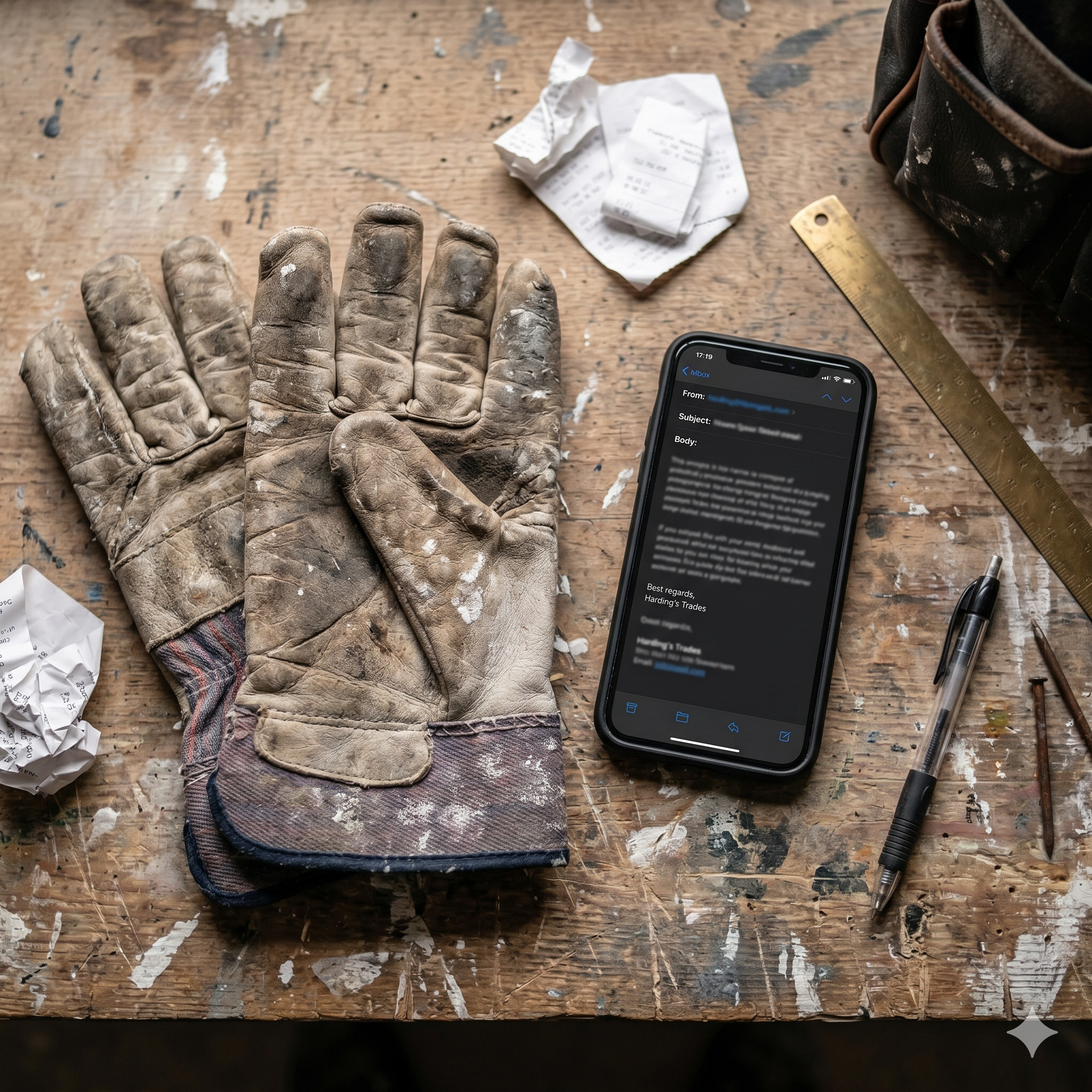
None of this requires you to become a better writer. It requires you to use a tool that writes well on your behalf.
The Seven Scenarios (With Prompts)
1. Booking Confirmation
After a customer accepts your quote and you agree a start date, send a confirmation. It sets expectations, reduces the chance of a no-show, and looks professional.
Prompt: "I'm a [TRADE] and a customer has confirmed they want to go ahead with a job. Write me a short, professional booking confirmation email. The job is [DESCRIBE JOB]. The agreed start date is [DATE]. My deposit requirement is [AMOUNT/PERCENTAGE]. Include the key details and a friendly but professional tone. Sign off as [YOUR NAME], [BUSINESS NAME]."
2. Quote Follow-Up (No Response After 3–5 Days)
The customer went quiet after you sent the quote. This is normal. A polite nudge wins jobs that would otherwise be lost to inertia.
Prompt: "I sent a written quotation to a customer [X] days ago and haven't heard back. Write me a short, professional follow-up email to check in without being pushy. The quote was for [JOB TYPE]. Keep it brief two or three sentences and close with a clear invitation to ask any questions or discuss the quote. Sign off as [NAME], [BUSINESS NAME]."
3. Managing a Delay or Change in Schedule
Work overruns. Materials are delayed. Weather intervenes. The way you communicate a schedule change determines whether a customer stays calm or becomes a problem.
Prompt: "I need to let a customer know that their job start date has to move. The original start date was [DATE]. The new proposed date is [DATE]. The reason is [BRIEF REASON]. Write me a professional, apologetic but confident email that explains the situation, confirms the new date, and reassures them the quality of work won't be affected. Sign off as [NAME], [BUSINESS NAME]."
4. Requesting a Deposit Before Starting
Some customers push back on deposits. A well-worded explanation of why deposits are standard practice removes the friction without you having to argue the case in person.
Prompt: "A customer has queried why I'm requesting a deposit before starting work. Write me a professional, reassuring response that explains the standard business reasons for deposits (material costs, scheduling, etc.) without being defensive. Keep it warm but clear. I require [AMOUNT/PERCENTAGE] before starting. Sign off as [NAME], [BUSINESS NAME]."
5. Friendly Payment Chaser
Invoice due. No payment. First reminder.
Prompt: "I need to chase a customer for payment of an invoice that was due [X] days ago. The invoice total is [AMOUNT]. This is the first reminder. Write me a short, polite payment reminder email that assumes it may have been an oversight. Include the invoice reference [REF NUMBER] and my preferred payment method. Keep it professional and friendly. Sign off as [NAME], [BUSINESS NAME]."
6. Firm Second Notice Payment Chaser
Still nothing. Time to be clearer.
Prompt: "This is the second payment chaser for an overdue invoice. The invoice for [AMOUNT] has been outstanding for [X] days. I've already sent one polite reminder. Write me a firm but professional email that sets a clear deadline of 7 days for payment and notes that I reserve the right to apply a late payment charge under the Late Payment of Commercial Debts (Interest) Act 1998. The tone should be serious but not aggressive. Sign off as [NAME], [BUSINESS NAME]."
7. Responding to a Complaint
This is where most tradespeople freeze. A complaint email arrives and you either respond too defensively, too apologetically, or not at all. Claude.ai helps you find the right tone when you're too close to the situation.
Prompt: "A customer has sent me this complaint: [PASTE THEIR MESSAGE]. I am a [TRADE]. Here is my perspective on the situation: [EXPLAIN YOUR VIEW]. Write me a professional response that acknowledges their concern, explains my position calmly and clearly, and proposes a reasonable resolution. I want to resolve this without it escalating. Sign off as [NAME], [BUSINESS NAME]."
A Note on Tone-Checking
If you're unsure whether your own draft email hits the right note before sending, paste it into Claude.ai and ask:
"Read this email I've written to a customer. Does the tone come across as professional and appropriate? Is there anything I should change?"
It takes ten seconds and has saved more than a few customer relationships from unnecessary friction.
The Time Maths
If each of these seven email types takes you an average of 15 minutes to write yourself. Staring at the screen, deleting and rewriting, that's over an hour and forty-five minutes per week if you're sending a few of each. Claude.ai reduces that to under ten minutes total.
That's not a marginal gain. That's a systematic removal of one of the most consistent drains on your evening.