The AI-Powered Trade Business: Your 90-Day Roadmap to Hyper Efficiency
You know what is possible. The question is what order to build it in. Tradespeople who try to change everything at once change nothing. This post gives you a systematic 90-day implementation plan, one improvement at a time.



Series: Claude.ai for Tradespeople | Post 12 of 12
You've read the series. You understand what's possible. Now the question is: in what order do you actually build this?
The answer matters more than most people think. The tradespeople who try to change everything at once change nothing. The ones who work through a systematic implementation, one improvement at a time, each one becoming habit before the next is added end up with an entirely different business within three months.
This is your 90-day roadmap. It's built around the principle that every small operational improvement compounds. The 1% gains from Post 2 were not a metaphor. They're the architecture of what you're about to build.
Before You Start: The Baseline Audit
Before you change anything, spend 30 minutes answering these questions honestly. They establish your starting point.
- How long does it currently take you to produce a quote after a site survey?
- How many quotes do you send within 24 hours of a visit?
- How many Google reviews do you currently have?
- How many times per month do you post to social media?
- Do you have written SOPs for any of your processes?
- How organised are your financial records right now (1–10)?
- How many hours per week do you spend on admin tasks?
Write these down. You'll return to them at the end of 90 days.
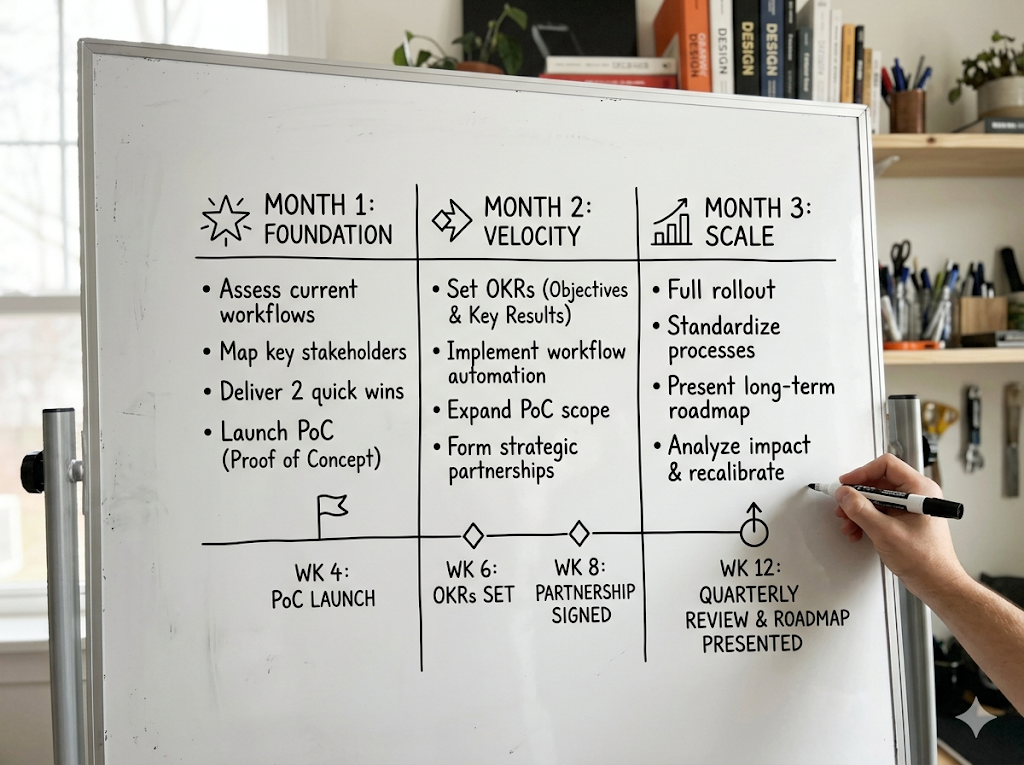
Month 1: Foundation (Weeks 1–4)
The goal of Month 1 is to eliminate the biggest, most frequent admin bottlenecks. Start here because the wins are immediate and visible, they build confidence and motivation to continue.
Week 1 :Quoting: Set up Claude.ai (free account). Build your quoting prompt using the template from Post 3. Send your next three quotes using Claude.ai. Measure the time saved vs. your previous approach.
Week 2 : Customer Comms: Build your seven customer communication templates from Post 4. Load the most-used ones as WhatsApp Business Quick Replies. Never write a booking confirmation or payment chaser from scratch again.
Week 3 : Review System: Set up your Google review link. Draft your review request message using Post 6. Commit to sending it within 48 hours of every completed job where the customer expressed satisfaction.
Week 4 : Job Sheets: Start using voice notes at the end of each job or day. Run them through the job sheet prompt from Post 5. Build the habit of ending every job with documentation, not just a handshake.
Month 1 target: You should be saving a minimum of 3 hours per week on admin. Quotes going out faster. At least 2–3 new Google reviews. Job documentation improving consistently.
Month 2: Velocity (Weeks 5–8)
Month 1 removed friction. Month 2 builds momentum adding the systems that make your business visible and scalable.
Week 5 : Social Media: Block two hours on a Sunday. Follow the process from Post 7. Produce six weeks of content in that single session. Schedule it using Meta Business Suite.
Week 6 : Financial Admin: Review your invoicing process. Create a professional invoice template using the Post 8 prompt. Set up a simple weekly habit: every Friday, log your week's expenses with clear categorisation notes. Fifteen minutes. Done.
Week 7 : Document 1 of Your Business Bible: Pick your most common job type. Use the brain dump approach from Post 10. Spend 20 minutes speaking your process aloud, paste the transcript into Claude.ai, and produce your first SOP.
Week 8 : Review and Refine: Look back at the last four weeks. What's working? What did you skip? What needs adjusting? Don't add new systems yet — tighten what you've already built.
Month 2 target: Social media posting consistently. Financial records cleaner than they've ever been. One SOP documented. Google reviews growing week on week.
Month 3: Scale (Weeks 9–12)
Month 3 is where you start building the infrastructure that lets the business operate beyond your personal capacity and opens doors to bigger opportunities.
Week 9 : Tender Readiness: Write your capability statement using the Post 9 prompt. Research two or three commercial contracts or approved supplier lists in your area.
Week 10 : Employee or Apprentice Prep: Even if you're not hiring yet, produce your induction pack (Post 10) and your customer service standards document.
Week 11 : Connected Stack: Review the tools you're using (Post 11). Are you on WhatsApp Business? Is your Google Business Profile active and being posted to? Remove the tools that aren't earning their place. Tighten the ones that are.
Week 12 : The 90-Day Review: Return to your baseline audit from Day 1. Answer the same questions.
- How long does it take to produce a quote now?
- How many Google reviews do you have?
- How many hours per week are you spending on admin?
- How does the business feel compared to 90 days ago?
The answers will be different. That's the point.
What Hyper Efficiency Looks Like for a Trade Business
A trade business operating at full efficiency with the system described across this series looks like this:
Quotes go out the same day as the site visit. Customer communication is professional, consistent, and mostly templated. Google reviews accumulate every week without you having to think about it. Social media posts appear regularly without you spending Sunday evenings stressing about captions. Job documentation is clean and complete. Financial records are tidy enough that year-end takes hours, not weeks. The business has documented processes that mean you could bring someone in tomorrow and have them operating to your standards within a week.
That's not a hypothetical. It's an achievable, realistic operational state built not through a single dramatic change, but through a series of small, systematic improvements that compound over time.
Kaizen. Continuous, incremental improvement. Koritsu. Machine-led velocity at every step.
One Final Thought
AI tools like Claude.ai will keep improving. The gap between trade businesses that adopt them and those that don't will keep widening. The tradespeople reading this series in 2026 are early not so early that the tools aren't ready, but early enough that adopting them now creates a meaningful competitive advantage before they become standard.
The work doesn't get done by reading about it. It gets done by opening Claude.ai this week and sending one better quote than you sent last week.
Start there. The rest follows.