Build Your Business Bible: Document Your Trade Knowledge with Claude.ai
Everything your business knows lives in your head. The moment you are ill or a key person moves on, it walks out the door. This post shows you how to use Claude.ai to document your standards, procedures and knowledge into one practical reference.


Series: Claude.ai for Tradespeople | Post 10 of 12
Everything your business knows right now lives in your head.
The way you like jobs quoted. The order you work through a bathroom installation. How you handle a customer who changes scope mid-job. What you tell a new apprentice on their first day. The standard for how a van should be stocked at the start of the week. All of it locked inside the knowledge of one or two people, and completely inaccessible the moment they're on annual leave, ill, or one day decide to move on.
This is the hidden fragility in most trade businesses. And it's entirely fixable not with a complicated knowledge management system, but with Claude.ai and a few hours of structured thinking.
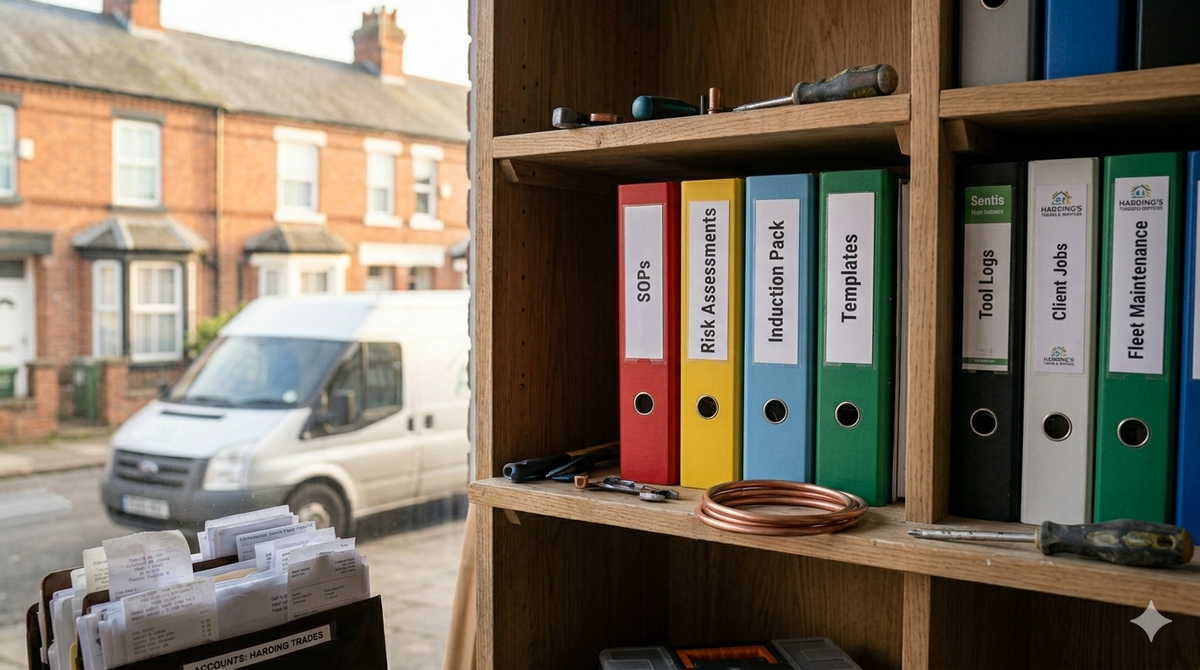
The document you'll build is what we call your Business Bible: a set of written standards, procedures, and guidance documents that let your business operate consistently, regardless of who's on site.
Why This Is an Advanced Priority, Not a Nice-to-Have
A trade business can function without documented processes when it's just you. The moment you take on staff even one person, the gap between "how you do it" and "how they do it" becomes the source of callbacks, quality issues, and customer complaints.
Documented standards close that gap. They also make your business more valuable if you ever want to sell it, more resilient when key people are absent, and more credible to commercial clients who want evidence of a managed quality system.
Claude.ai makes building these documents possible for tradespeople who don't consider themselves writers which is most of them.
Document 1: Standard Operating Procedures (SOPs)
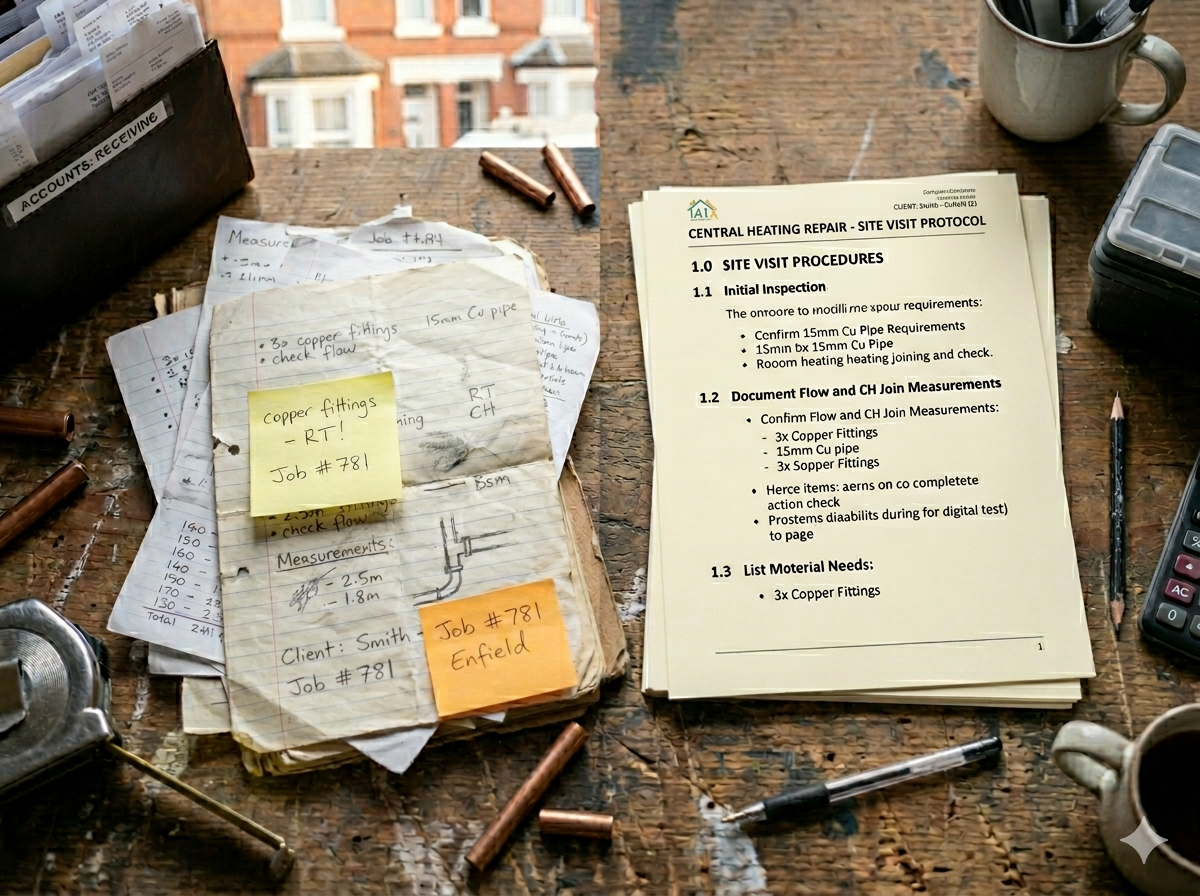
An SOP describes how a specific, recurring task should be carried out — step by step — to the standard you expect every time.
Prompt: "I am a [TRADE] and I want to write a Standard Operating Procedure for [SPECIFIC JOB/TASK].
Here is how I currently approach this job:
[DESCRIBE YOUR PROCESS — as rough and detailed as you like. Include the order you do things, any specific standards you maintain, things you always check, common mistakes to avoid, quality checks at the end.]
From this description, write me a clear, numbered SOP that a competent tradesperson with [X years' experience / apprentice level] could follow. Use plain English. Include a quality checklist at the end."
Document 2: New Employee / Apprentice Induction Pack
Prompt: "I am a [TRADE] and I want to create an induction document for new employees and apprentices joining my business, [BUSINESS NAME].
My business operates in [AREA] and our typical work involves [DESCRIBE YOUR CORE WORK TYPES].
Please create an induction pack that covers:
1. Introduction to the business, who we are, how we work, what we stand for
2. Working hours, punctuality, and attendance expectations
3. Van and equipment standards (if applicable)
4. Health and safety responsibilities and reporting
5. Customer interaction standards, how to speak to customers, what to say, what not to say
6. Quality standards, what 'finished' looks like in our business
7. How to report problems or raise concerns
8. Probationary period expectations
My specific standards include: [ADD ANY SPECIFIC RULES OR STANDARDS YOU HOLD]
Keep the tone firm but welcoming. This should feel like the business has its act together."
Document 3: Customer-Facing Service Standards
Prompt: "I want to document my customer service standards for my trade business, [NAME]. Write me a one-page Customer Experience Standard that describes:
- How quickly we respond to initial enquiries (target: [X hours])
- How we conduct site visits and surveys
- How we communicate during the job (frequency of updates, handling of unexpected findings)
- How we leave the site at the end of each day and on completion
- How we handle complaints or concerns
- Our follow-up process after job completion
My current approach is: [DESCRIBE HOW YOU CURRENTLY HANDLE EACH OF THESE]
Make this document suitable for both internal use (training staff) and potential external use (demonstrating our quality standards to commercial clients). Formal but not corporate."
Document 4: Van and Equipment Checklist
Prompt: "I am a [TRADE] and I want to create a weekly van stock and equipment checklist for my team. Write me a comprehensive checklist covering:
- Core tools that should always be in the van (I'll tell you what these are: [LIST YOUR STANDARD TOOLS])
- Consumables that need to be restocked when low
- PPE items (minimum requirement per person)
- Documentation items (e.g., blank job sheets, invoice pads, certificate pads)
- First aid kit check
Format it as a checkable list with a space for the driver's name and date. Keep it on one page."
The Brain Dump Approach
The hardest part of building your Business Bible is not the writing Claude.ai does that. It's the extraction. Getting the knowledge out of your head and into a format Claude.ai can work with.
The most effective approach is a brain dump. For each document you want to create, spend ten minutes speaking aloud (or typing) everything you know about that topic, no structure, no editing, just everything that comes to mind. Paste the raw output into Claude.ai with the relevant prompt above.
You are the subject matter expert. Claude.ai is the editor.
Building the Library Over Time
You don't need to write your entire Business Bible in one weekend. Add one document per month. After twelve months, you have a comprehensive operational framework that most trade businesses ten times your size don't have.
The business that has this documented infrastructure is the one that's ready to scale, ready to hand off, and ready to take on commercial contracts that require evidence of a managed quality system.