What is Machine Learning (ML)?
Machine Learning explained for estate agents. Understand how AI learns from data to score leads, value properties, and match buyers. Learn when ML justifies the investment vs. simple automation. Includes questions to ask vendors about training data and accuracy rates. No jargon, just facts.
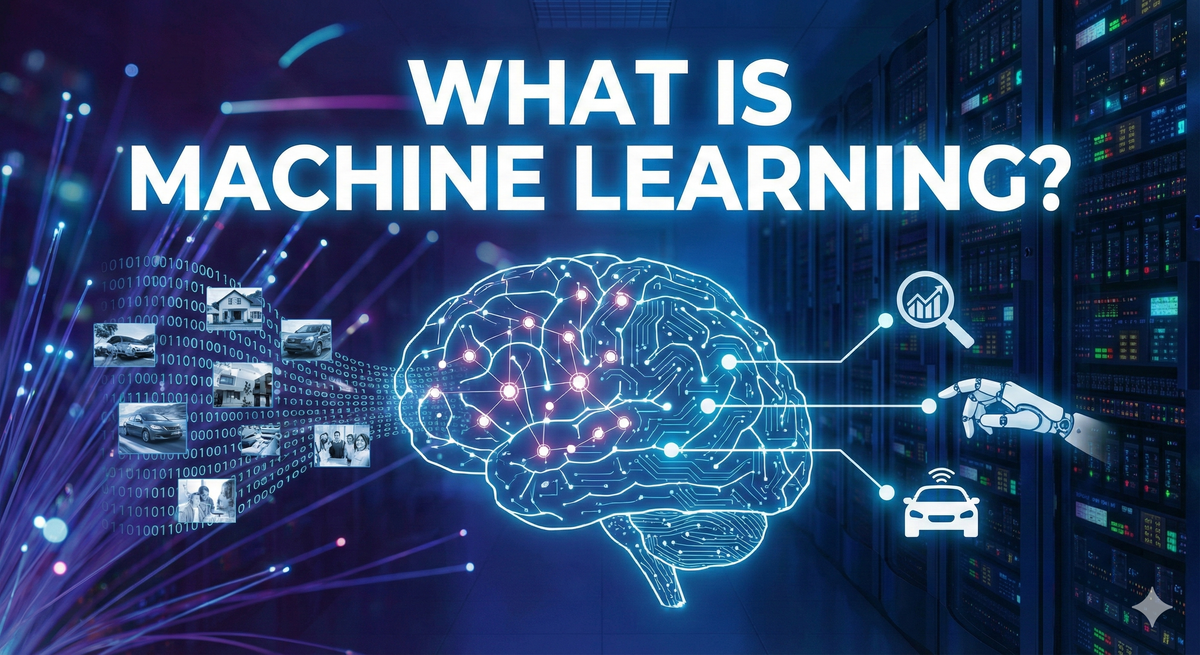
In plain English: Machine Learning is when computers learn from examples rather than following explicit instructions. Instead of programming every rule manually, you show the system thousands of examples, and it figures out the patterns on its own. It’s the most common type of AI you’ll encounter in estate agency tools.
Why It Matters to Estate Agents
Machine learning is the engine behind most genuinely useful “AI” in property technology. It’s what makes:
- Lead scoring systems identify which enquiries are worth your immediate attention
- Automated valuations analyze comparable sales to suggest property prices
- Chatbots understand what buyers are actually asking for, even when they phrase it differently
- Property matching recommend listings to buyers based on their behavior, not just their stated criteria
Understanding how machine learning works helps you evaluate these tools intelligently. You’ll know when a vendor’s ML system is likely to work well for your business—and when it’s likely to fail.
The critical difference from traditional programming: With traditional software, you tell the computer exactly what to do. With machine learning, you show it what you want, and it figures out how to do it.
Here’s why this matters: Property markets change. Buyer preferences evolve. What worked in 2019 doesn’t work in 2024. Traditional rule-based systems require constant manual updating. Machine learning systems adapt automatically as they process new data.
Real-World Example: Lead Qualification
Traditional Approach (No Machine Learning):
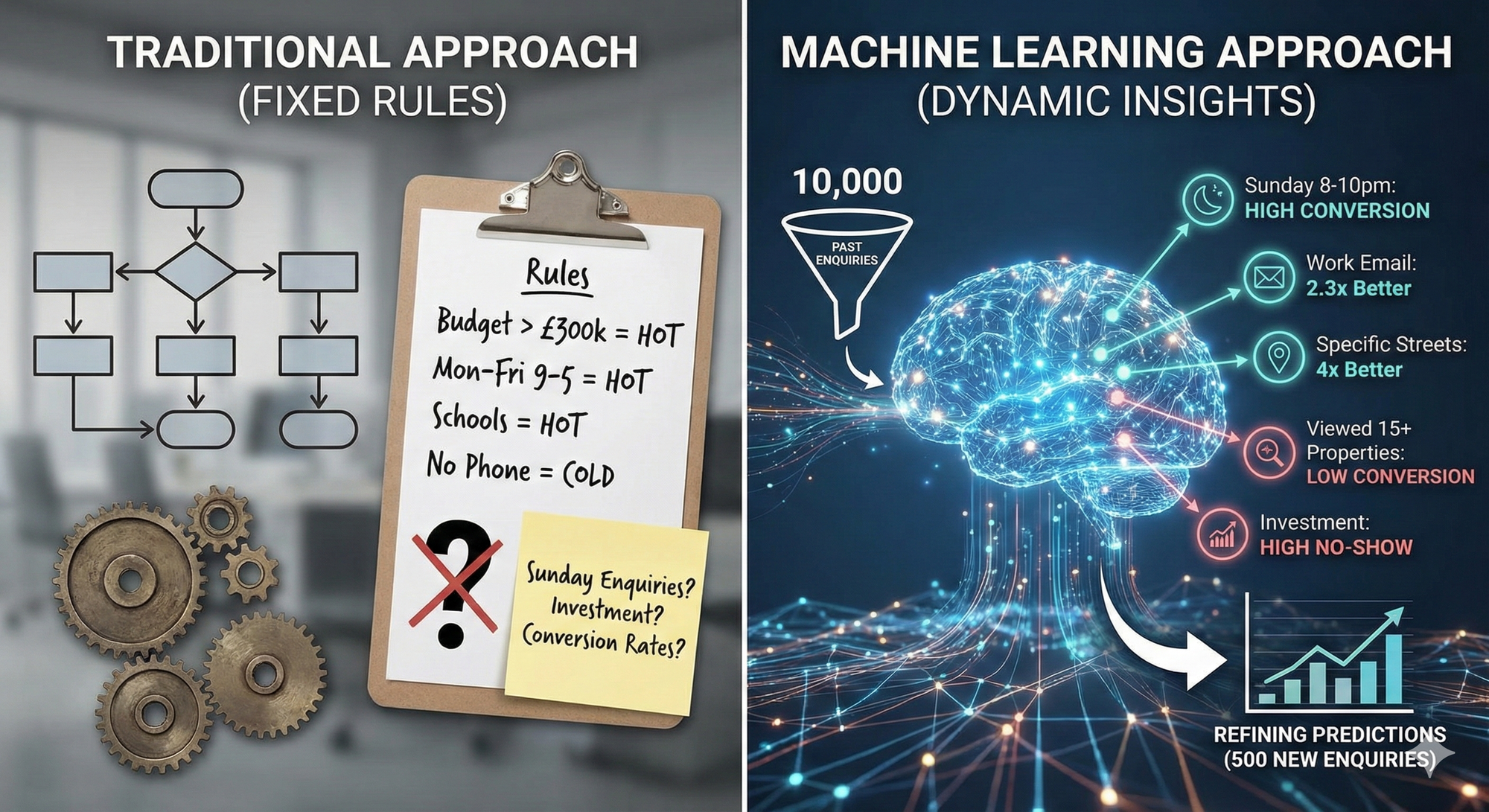
You manually create rules in your CRM:
- Budget over £300,000 = Hot Lead
- Enquired Monday-Friday 9am-5pm = Hot Lead
- Asked about school catchments = Hot Lead
- Generic enquiry with no phone number = Cold Lead
This works… until it doesn’t. You don’t know that buyers who enquire on Sunday evenings actually convert at the highest rate. Or that mentioning “investment” in the message predicts a 73% no-show rate at viewings. You’ve codified your assumptions, not reality.
Machine Learning Approach:
You feed your CRM 10,000 past enquiries with outcomes (viewed property, made offer, completed purchase, or never responded). The ML system analyzes everything:
- Time and day of enquiry
- Email domain (@gmail vs. @company.co.uk)
- Word choices in the message
- How many properties they’ve viewed on your site
- Whether they opened your automated response
- Device used (mobile vs. desktop)
It discovers that:
- Buyers using work email addresses convert 2.3x better
- Enquiries mentioning specific street names convert 4x better than enquiries just asking about “the area”
- People who view 15+ properties before enquiring almost never convert
- Sunday 8-10pm enquiries convert better than Tuesday morning
You never told it to look for these patterns. It found them in your data. Next month, it processes 500 new enquiries and refines its predictions. It’s learning what actually predicts serious buyers in your market, not following generic rules.
Common Misconceptions
“Machine learning needs millions of data points.” For many estate agency applications, a few thousand examples are enough. Your CRM probably has sufficient historical data right now to build useful ML models for lead scoring or property matching.
“Machine learning is 100% accurate.” No. ML systems are probabilistic—they make educated guesses based on patterns. A lead scorer might be 85% accurate, meaning 15% of “hot” leads won’t convert, and you’ll miss some genuine buyers scored as “cold.” The question isn’t perfection—it’s whether ML beats your current manual approach.
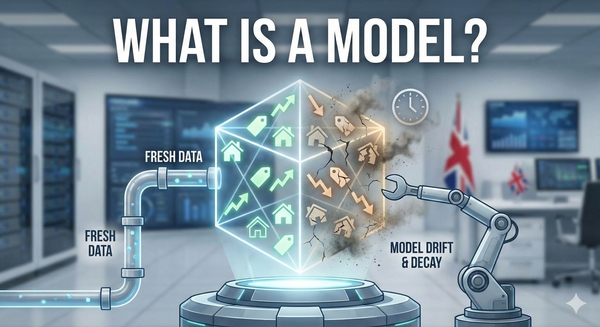
“Once trained, ML systems stay accurate forever.” Markets change. Buyer behavior evolves. An ML model trained on 2019 data will perform poorly in 2024 if it hasn’t been retrained. Good ML systems require regular retraining on fresh data—this is a feature, not a bug.
“ML is too technical for non-programmers.” Using ML systems requires zero programming knowledge. Building them from scratch is technical. But using ML-powered lead scoring or property recommendations? You’re probably already doing it without realizing it.
Questions to Ask Vendors
When evaluating ML-powered tools:
- “What data does your system learn from?” The quality and relevance of training data determines everything. An ML system trained on London luxury flats won’t work well for Manchester terraced houses.
- “How often do you retrain the model with fresh data?” Monthly is good. Quarterly is acceptable. Annually is questionable. “We trained it once in 2022” is a red flag.
- “What’s your accuracy rate for [specific task]?” Don’t accept vague claims. A lead scorer should quote precision/recall metrics. A valuation tool should state its average margin of error.
- “Can I see how it performs on my historical data?” Before committing, insist on seeing the ML system analyze your past 6-12 months of data. Does it correctly identify patterns you know exist?
- “What happens with edge cases or unusual properties?” ML systems struggle with unusual situations they haven’t seen in training data. How does their system handle a listed building, a property with land, or a house next to a proposed development?
How Machine Learning Actually Works (Simplified)
Think of ML like teaching a child to identify dogs:
Traditional programming approach: You’d write rules: “If it has four legs, fur, a tail, and barks, it’s a dog.” But this fails for three-legged rescue dogs, breeds that rarely bark, or hairless dogs.
Machine learning approach: You show the child 1,000 photos: “Dog. Dog. Not dog (that’s a cat). Dog. Not dog (that’s a wolf).” Eventually, the child recognizes patterns you never explicitly described—ear shape, eye position, overall proportions. They can identify dogs they’ve never seen before.
ML in estate agency works the same way:
- Feed it examples (past enquiries, property sales, viewing outcomes)
- Tell it which outcomes you care about (conversion, sale price, viewing attendance)
- Let it find patterns that predict those outcomes
- Test its predictions against new data
- Refine and retrain regularly
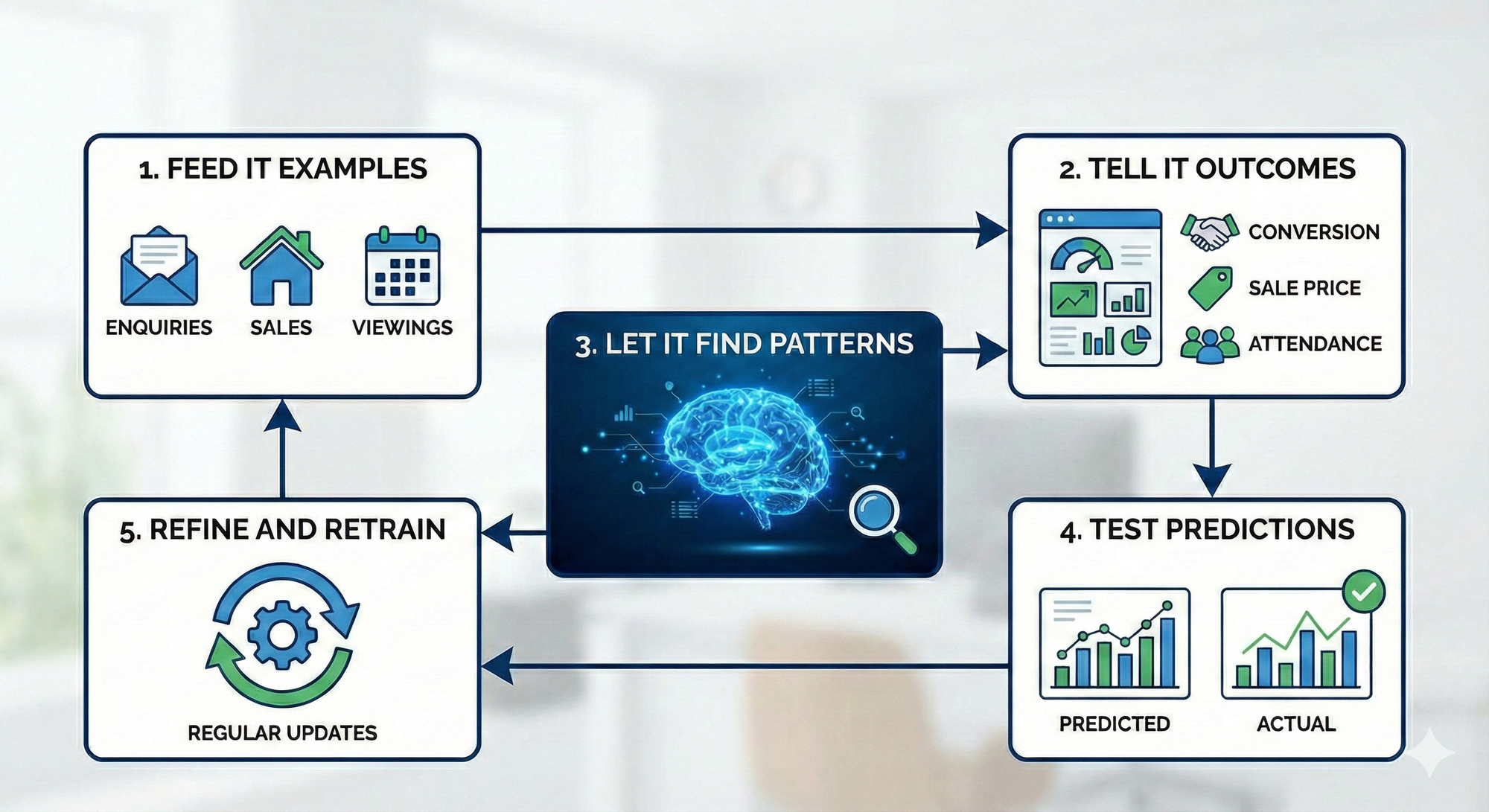
You don’t need to understand the mathematics. You need to understand the principle: show it good examples, and it learns patterns.
The Bottom Line
Machine learning is the practical, working AI you’ll actually use in estate agency. It’s not magic—it’s pattern recognition at scale, applied to tasks that benefit from analyzing large amounts of data.
The best ML systems in property don’t replace your expertise—they handle the tedious analysis so you can focus on what requires human judgment: building relationships, negotiating deals, and advising clients through complex decisions.
When a vendor says their tool uses ML, you now know the right questions to ask to separate genuine capability from marketing spin.
Related Terms
- Training Data - The examples ML systems learn from (your next “What Is A…” article)
- Supervised Learning - Teaching ML by showing it correct answers
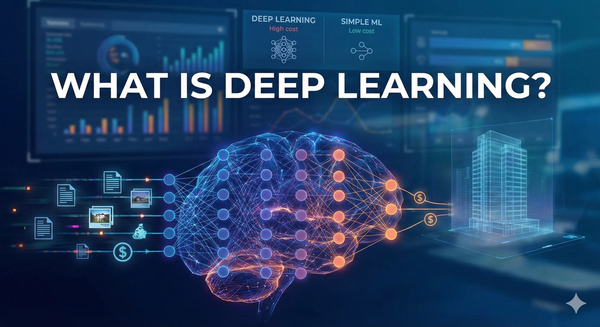
- Deep Learning - Advanced ML that powers tools like property description generators