What is Deep Learning?
Deep Learning powers ChatGPT and property description generators. Learn when this expensive AI technology is worth it vs. when simpler ML works better. Includes cost-benefit analysis for estate agents and real examples comparing deep learning to traditional approaches. Make informed decisions.
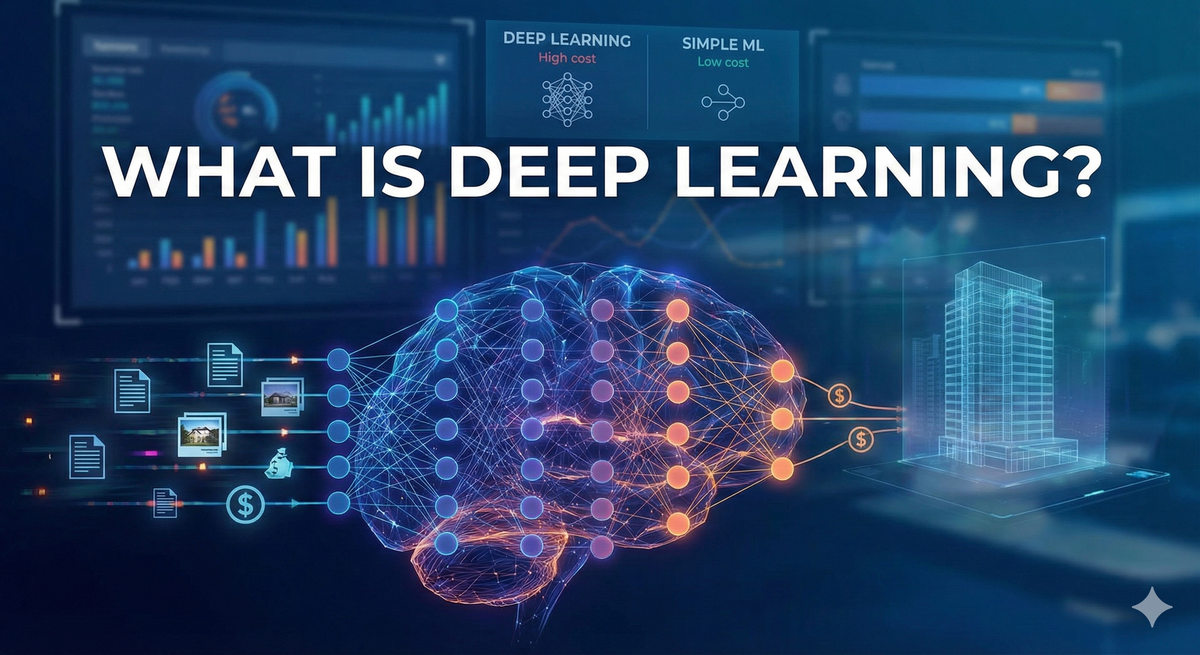
In plain English: Deep Learning is a sophisticated type of machine learning that uses artificial neural networks (inspired by how human brains work) to find complex patterns in data. It’s the technology behind AI that writes property descriptions, recognizes features in photos, and understands natural language. Think of it as machine learning’s more powerful, more expensive cousin.
Why It Matters to Estate Agents
Deep learning powers the most impressive AI tools in property technology:
- ChatGPT and property description writers use deep learning to generate human-like text
- Virtual staging tools use it to add furniture to empty room photos
- Image recognition identifies property features (kitchen, garden, period features) automatically
- Advanced chatbots understand complex buyer questions and respond naturally
Here’s the key question for estate agents: Do you actually need deep learning, or would simpler (and cheaper) machine learning do the job?
Deep learning is incredibly powerful but has trade-offs:
- More expensive to run (costs more per query)
- Requires massive amounts of training data
- Can be unpredictable (the “hallucination” problem)
- Harder to explain why it made a specific decision
Sometimes you need this power. Sometimes you’re paying for Ferrari performance when a Ford would do the job perfectly well.
Real-World Example: Property Descriptions
Let’s compare three approaches to generating property descriptions:
Template System (No AI):
This [bedrooms]-bedroom [property type] in [area] features [list of amenities].
Perfect for [buyer type]. Priced at [price].
Result: “This 3-bedroom semi-detached in Didsbury features a modern kitchen, garden, and driveway. Perfect for families. Priced at £425,000.”
Functional but robotic. Everyone can tell it’s automated.
Simple Machine Learning:
Analyzes 10,000 of your best-performing listings to learn which phrases drive engagement. Suggests: “Use ‘beautifully presented’ for properties with high-quality photos” or “mention ‘peaceful location’ for properties on quiet streets.”
Still requires human writing, but with AI-powered suggestions.
Deep Learning (GPT-4, Claude):
You input: “3-bed semi, Didsbury, modern kitchen, large garden, Victorian features, £425,000”
It generates: “Nestled in the heart of Didsbury’s most sought-after roads, this beautifully renovated Victorian semi-detached home seamlessly blends period charm with contemporary living. The thoughtfully extended kitchen opens onto a surprisingly generous south-facing garden—a genuine rarity for the area. With three well-proportioned bedrooms and meticulous attention to detail throughout, this is that rare find: a characterful family home where you can simply move in and enjoy.”
This sounds human. It makes connections (Victorian features + modern kitchen = “seamlessly blends”), uses evocative language, and creates an emotional appeal. That requires deep learning’s ability to understand context and generate creative, coherent text.
Common Misconceptions
“Deep learning is always better than simpler ML.” Not true. For lead scoring (hot vs. cold), simple ML often outperforms deep learning because it’s more predictable and easier to calibrate. Deep learning shines when you need to handle unstructured data like text, images, or speech.
“Deep learning is completely autonomous.” Even the best deep learning systems need human oversight, especially in estate agency. A property description generator might occasionally “hallucinate” features that don’t exist. Image recognition might misidentify a conservatory as a greenhouse. Human review is essential.
“You need to understand neural networks to use deep learning tools.” You don’t need to understand how a car engine works to drive. Similarly, you don’t need to understand neural network architecture to use ChatGPT effectively. You do need to understand its limitations and where it can make mistakes.
“Deep learning will solve every problem.” It won’t. Deep learning excels at pattern recognition in complex data (images, language, audio). It’s often overkill for simpler tasks like lead scoring or appointment scheduling. Don’t pay deep learning prices for problems that simple ML solves perfectly well.
Questions to Ask Vendors
When evaluating tools that use deep learning:
- “Why does this application require deep learning rather than simpler ML?” If they can’t articulate why the extra power is necessary, you might be paying for unnecessary sophistication.
- “What happens when the system makes an error?” Deep learning can be confidently wrong. How do they catch and prevent mistakes? Is there human review? Error detection?
- “How do you prevent hallucinations or false information?” Critical for any system generating text or making recommendations. What guardrails exist?
- “What’s the cost per use?” Deep learning is computationally expensive. Generating one property description might cost 10-50p in API fees. At scale, this adds up. Understand the pricing structure.
- “Can you explain why it made that decision?” Deep learning models are “black boxes”—they can’t always explain their reasoning. For compliance-critical applications (fair housing, lending), this can be a problem.
When Deep Learning Makes Sense
Use deep learning for:
- Content generation - Property descriptions, social media posts, email responses
- Image analysis - Identifying features in property photos, virtual staging
- Natural language processing - Chatbots that understand complex questions, extracting information from unstructured text
- Voice assistants - Systems that understand spoken requests
Skip deep learning for:
- Simple classification - Hot vs. cold leads, property type categorization
- Numerical predictions - Property valuations (simpler ML often more accurate)
- Rule-based workflows - Automated email sequences, appointment booking
- Straightforward data analysis - Spreadsheets, sales reports, basic statistics
How Deep Learning Differs From Other ML
Standard machine learning might analyze these features to score a lead:
- Budget stated
- Time of enquiry
- Geographic location
- Email vs. phone enquiry
It applies statistical patterns you could theoretically calculate manually (though you wouldn’t want to).
Deep learning looks at the actual text of an enquiry and understands:
- Urgency in the language (“need to move by July” vs. “just browsing”)
- Specificity (“interested in 23 Oak Road” vs. “what’s available?”)
- Emotional tone (excited vs. cautious)
- Implied requirements not explicitly stated
This contextual understanding requires neural networks with millions of parameters analyzing the relationships between words, phrases, and meanings. That’s deep learning.
The Cost-Benefit Reality
Deep learning costs more because:
- Requires massive computing power to run
- Often needs cloud APIs (ongoing costs per use)
- Can’t run on basic hardware
- May need expert configuration
It’s worth it when:
- The value of improvement exceeds the cost (better descriptions = more viewings = more sales)
- Simpler approaches have failed
- You’re handling truly complex, unstructured data
- Scale justifies the investment (generating 100+ descriptions monthly)
It’s not worth it when:
- Simple ML delivers 90% of the benefit at 10% of the cost
- Your use case is straightforward classification or prediction
- Volume is too low to justify per-use costs
- You don’t have resources to properly review outputs
The Bottom Line
Deep learning is powerful, impressive, and genuinely useful for specific estate agency tasks—particularly anything involving language or images. It’s also expensive, occasionally unpredictable, and complete overkill for many applications.
The smartest estate agents use deep learning where it delivers genuine value (content generation, image analysis, natural language understanding) and simpler, cheaper ML everywhere else.
Don’t be dazzled by “powered by deep learning” marketing. Ask whether the specific problem you’re solving actually benefits from that extra power—and whether you’re willing to pay for it.
Related Terms
- Neural Networks - The architecture that makes deep learning work
- Large Language Models (LLMs) - ChatGPT, Claude, and other text-generation systems
- Generative AI - AI that creates new content (text, images, code)