What is Artificial Intelligence (AI)?
Learn what AI actually is vs. marketing hype. Understand the difference between genuine AI and simple automation in estate agency tools. Discover how to spot overhyped vendor claims and make smarter PropTech buying decisions. Essential reading for UK estate agents evaluating AI solutions.

In plain English: Artificial Intelligence is when computers perform tasks that normally require human intelligence—like understanding language, recognizing patterns, making decisions, or learning from experience. It’s not a single technology, but a spectrum ranging from simple rule-following systems to sophisticated programs that can learn and adapt.
Why It Matters to Estate Agents
You’re being sold “AI” everywhere. Your CRM provider claims AI-powered lead scoring. A chatbot vendor promises AI that “never sleeps.” Another PropTech startup guarantees their AI will “revolutionize viewings.”
But here’s the uncomfortable truth: most of what’s being sold as “AI” to estate agents is either basic automation dressed up in fancy language, or genuinely useful technology wrapped in jargon designed to justify premium pricing.
Understanding what AI actually is helps you:
Spot genuine value vs. marketing hype. When you know the difference between true AI and simple automation, you can’t be bamboozled by vendors throwing around buzzwords. A system that sends automated emails when a lead enquires isn’t AI—it’s a helpful automation, but it’s following predetermined rules you set.
Make smarter buying decisions. Real AI systems learn and improve over time. If a vendor can’t explain how their system learns, what data it trains on, or how it gets better with use, it’s probably not AI. And that’s fine—but you shouldn’t pay AI prices for automation.
Set appropriate expectations. AI isn’t magic. It’s a tool that’s excellent at specific tasks (like analyzing thousands of property transactions to suggest a valuation) but can fail spectacularly at others (like understanding the emotional nuance in a grieving client’s request to delay a viewing). Knowing what AI can and can’t do prevents expensive disappointments.
Real-World Example: Property Valuation
Let’s look at how AI actually works in property valuation versus how automation works:
Traditional Automation (Not AI): You set rules in your system: “If property is a 3-bed semi in Manchester postcodes M20-M23, built 1990-2010, with a garden, apply £280,000-£320,000 based on condition.” The system follows your rules exactly, every time, forever—until you manually update them.
Actual AI (Machine Learning): The system analyzes 50,000 recent property sales in Greater Manchester. It discovers patterns you never explicitly programmed: properties within 400 meters of a Metrolink station sell for 12% more; homes with south-facing gardens add £15,000 in M20 but only £8,000 in M23; properties sold in March consistently fetch 3% more than identical properties in November.
The AI system didn’t follow your rules—it found patterns in real data and learned what actually predicts sale prices. Next month, when it processes 5,000 new sales, it refines its understanding. It’s genuinely learning, not just following instructions.
Common Misconceptions
“AI is too expensive for small agencies.” False. Basic AI tools like ChatGPT cost £20/month. Many CRMs include AI lead scoring at no extra charge. What’s expensive is custom-built AI specific to your business—but that’s rarely necessary.
“AI will replace estate agents.” Not remotely close. AI handles specific tasks (analyzing data, drafting descriptions, qualifying initial enquiries) but can’t replicate the emotional intelligence, negotiation skills, and relationship-building that define successful estate agency. AI is a tool that makes good agents better, not a replacement.
“If it’s automated, it’s AI.” This is the most common and expensive misconception. Automation follows rules you set. AI learns patterns from data. Your automated viewing reminder email isn’t AI. Your system that learns which leads are most likely to convert based on thousands of past enquiries? That’s AI.
Questions to Ask Vendors
When a vendor claims their product uses AI, ask:
- “Does your system learn from data, or does it follow predetermined rules?” If they can’t clearly explain how it learns, it’s probably automation marketed as AI.
- “What data does your AI train on, and how often is it updated?” Real AI systems need data to learn from and regular updates to stay accurate.
- “Can you show me how the system improves over time?” AI should get better with more data and use. If performance is static, it’s not learning.
- “What happens when your AI makes a mistake?” All AI systems have error rates. Honest vendors will explain theirs and how they’re mitigated.
The Bottom Line
AI is a powerful tool when used appropriately for tasks that benefit from pattern recognition and learning from large datasets. It’s not magic, it’s not going to replace your job, and it’s not always necessary.
Sometimes simple automation is exactly what you need. Sometimes AI delivers genuine competitive advantage. The key is knowing which is which—and now you do.
Related Terms
- Machine Learning - The most common type of AI used in estate agency tools
- Algorithm - The set of instructions AI follows (but it learns which instructions work best)
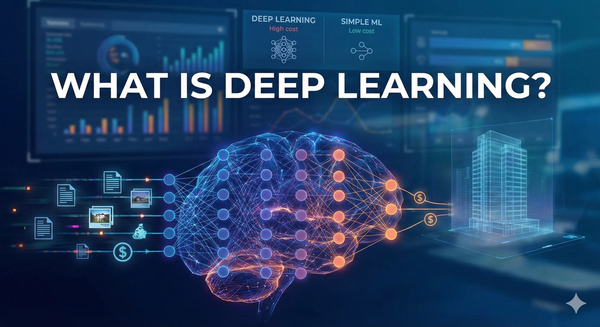
- Deep Learning - Advanced AI that powers image recognition and natural language tools